This story was originally published by Chalkbeat.
By Melissa Brown
Tennessee House Republicans on Monday passed legislation to track the immigration status of all public school children in the state, an effort that drew sharp rebukes from Democrats and immigration advocates.
The legislation requires that Tennessee public schools verify the citizenship or immigration status of each student enrolling, and then report anonymized data to the Tennessee Department of Education, state immigration officials, and state lawmakers.
Senate Republicans last year passed an earlier version of the bill that would allow Tennessee schools to charge undocumented students tuition.
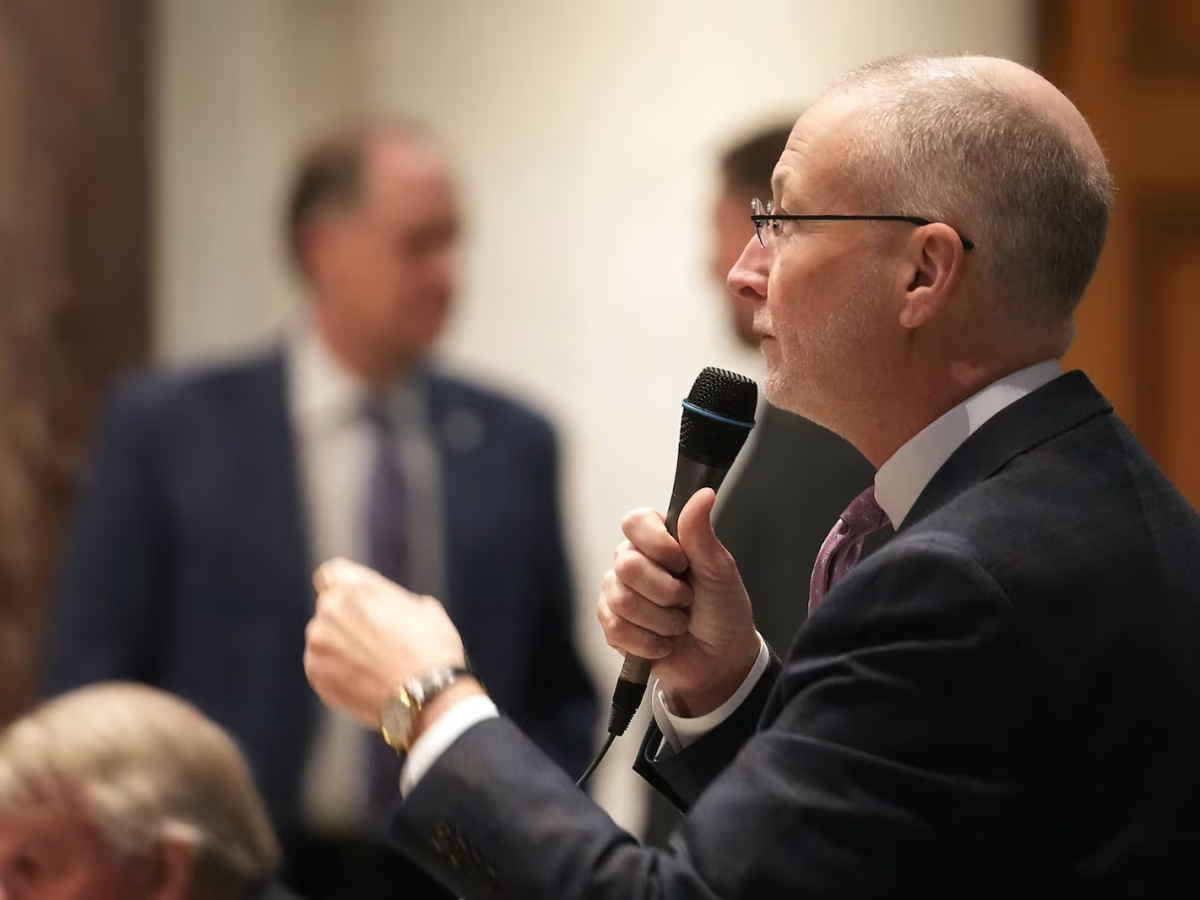
House Majority Leader William Lamberth argued on Monday that schools are already gathering birth certificate and local residency data, in addition to required medical records, and his legislation would not be an additional logistical problem for schools.
“This just asks for that data,” Lamberth, the Republican sponsor of the bill, said.
Rep. Gabby Salinas, a Memphis Democrat, urged colleagues not to be “fooled” by Lamberth’s arguments that the legislation is a simple data collection bill. Salinas pointed to previous comments from Lamberth that the bill is a vehicle to challenge Plyler v. Doe, a longstanding U.S. Supreme Court precedent guaranteeing a right to public education to all children.
“Our kids in Tennessee are not your legal experiment,” Salinas said.
Tennessee educators in recent months have disagreed with the Republican proposal to collect and verify the immigration status of nearly 1 million children in state public schools. In Knox County, a bipartisan school board has officially opposed the legislation. Educators in recent weeks have testified against the effort, citing logistical concerns and potential disruption to local communities.
“Is this just a pretext to getting information that we want so that ICE can come up here and disrupt families that are attempting to live lawfully?” Rep. Yusuf Hakeem, a Chattanooga Democrat, asked during the House debate.
Lamberth didn’t respond. During the floor debate on HB 836, though, the Republican majority leader suggested multiple times that opponents to the education bill were proponents of “open borders.”
The Monday vote was more than a year in the making.
In 2025, Lamberth and Sen. Bo Watson, both powerful lawmakers in Republican leadership, filed legislation that would allow public schools to block undocumented students from attending public schools.
The sponsors made clear they were targeting Plyler, rolling out a joint press release when the bill was filed amid a larger immigration push in the legislature last year.
The effort sparked weeks of heated protests at the Tennessee General Assembly, and the Republican sponsors worked to dial back their bills.
Senate Republicans eventually passed a version of the bill in a close vote that would allow public schools to charge undocumented students tuition.
In addition to challenging Plyler, the sponsors would later argue public schools are bearing an increasing financial burden to educate undocumented students, though Tennessee schools are largely funded through local sales tax paid by anyone purchasing groceries or gas in a community, for example.
Lamberth delayed his bill in 2025 amid pushback and concerns over whether the legislation would threaten more than $1 billion in federal education funding. He repeatedly said the U.S. Department of Education was working on guidance for lawmakers on the issue, but it has not publicly materialized and Lamberth amended the bill to just include data collection.
He acknowledged late last week he still expects the state to be sued over the legislation, should it pass into law.
“We will probably still get sued by some group out there that doesn’t think Tennesseans and their legislators should know how many illegal immigrant children are in our schools,” Lamberth said. “There’s going to be a group out there that doesn’t think we should be able to ask that. I think that’s ridiculous, but it’s likely still going to happen.”
With the passage of House Bill 793, the General Assembly’s two chambers now have two differing versions of the bill. The Senate could agree later this week to adopt the House version. Watson said Monday he hasn’t “paid a lot of attention” to the House version and would make a decision when it comes to the Senate later this week.
Melissa Brown is the bureau chief for Chalkbeat Tennessee. Contact Melissa at mbrown@chalkbeat.org.