

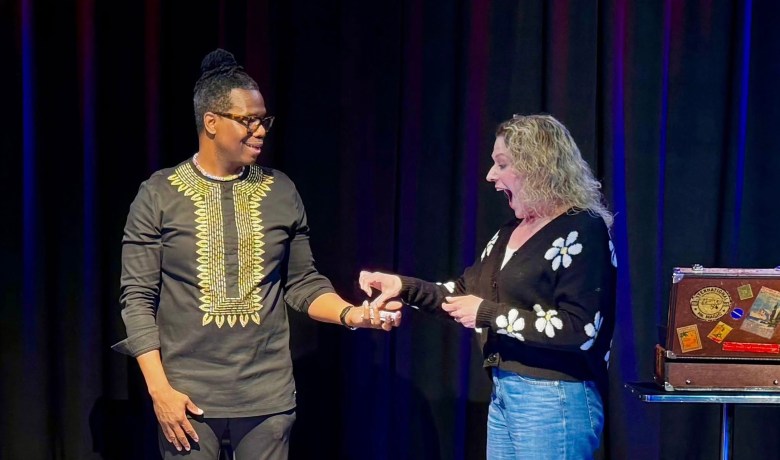
For magician and comedian Ran’D Shine, magic is more than making a playing card disappear or leaving an audience wondering, “How did he do that?” It is also about history, representation and telling Black stories that are often overlooked.
Shine will bring “The Heart & Soul of Magic” to the Halloran Centre of Performing Arts & Education at the Orpheum Theatre for a one-night-only performance on Saturday, Oct. 17 at 7:30 p.m. He will also host a free community magic workshop in the afternoon before the evening show for adults and children at least 10 years old.
The evening will feature an African American cast blending illusions, comedy, music and audience participation, and celebrating Black magicians, past and present. Shine will open the show — which is appropriate for all ages — before “tagging in” The Spellbinder, a respected Chicago magician.
“The theme is always honoring the past, recognizing the present, inspiring the future,” said Shine, whose personal mission grew out of his own unexpected journey into the profession.
Originally from Philadelphia, Shine was attending graduate school at Penn State University when a fraternity brother introduced him to magic.
“He showed me a card trick and I was hooked,” said Shine, who is a member of Alpha Phi Alpha Fraternity, Inc.
His academic pursuits initially focused on health education — a branch of public health — which led him to South Africa where he conducted community health research. While at the University of the Western Cape in Cape Town, he studied issues related to water sanitation and also taught a college course.
After returning to the United States, Shine worked in the University of Pennsylvania’s Department of Epidemiology and Biostatistics. While there, he decided to give magic a try for a year, which turned into 19 years of performing magic — and counting!
As his career grew and he found himself regularly attending magic conventions with thousands of participants, Shine noticed how few African American magicians attended these events.
He began questioning the absence of Black performers in a field with a rich but frequently overlooked history of contributions made by African Americans.
“I wanted to produce a show highlighting African American magicians,” he said.
Recovering that history is much like archaeological work — uncovering stories long buried or obscured by the social and political circumstances of their time, Shine said.
Among the figures he wants audiences to know is Richard Potter, widely recognized as the first American-born professional magician. Potter was of African descent and built a career performing in the early 19th century, when opportunities for Black entertainers were severely restricted.
Shine also points to Henry Box Brown, known for escaping enslavement by having himself shipped in a wooden crate to freedom in Philadelphia. Brown later became a magician and found success performing in Britain. Another figure, Black Herman, performed during an era when Black entertainers created opportunities for themselves despite segregation and discrimination.

“These stories need to be told,” Shine said, emphasizing that African American contributions to entertainment deserve recognition alongside those of “mainstream” performers.
He established “The Heart & Soul of Magic” to bring those stories to the stage while showing audiences what contemporary Black magicians can do.
“People say, ‘I’ve never seen a Black magician before,’” Shine said. “Let’s normalize Black magicians who are entertainers, who are doing something creative and innovative, and bring a style that is different.”
Shine is also intentional about how he describes his work. “Black magic” refers to magic performed by a Black entertainer, he said, not the dark or sinister associations sometimes attached to the phrase.
And Shine believes this dazzling form of entertainment and spiritual faith can coexist. Magic, he explains, is a form of performance, creativity and connection.
Although Saturday’s performance will be Shine’s first in Memphis, he believes the city’s cultural legacy, musical influence and history of resilience align with the show’s themes.
Still, diverse audiences should leave with more than memories of astonishing tricks, he said. He hopes attendees will learn some history, discover a new appreciation for the art form and enjoy an evening that provides a brief reprieve from life’s everyday pressures.
Part of magic’s power, Shine said, is opening people’s eyes to what is possible while giving them permission to imagine something beyond the ordinary.
“We are just facilitators for everyone to have a good time,” he stated. “and magic is the vehicle we will use to do this.”
For more information about the show, visit: https://www.orpheum-memphis.com/events/the-heart-soul-of-magic


